
01
Can we discuss whether the melanocortin system is relevant to my goals?
Why I'm asking: To determine if supporting these specific signaling pathways aligns with my personal biological needs.
Educational note
This web edition is presented as a body-intelligence learning guide. It is designed to support calmer observation, stronger pattern recognition, and provider-guided conversations around glow signaling, metabolic context, and internal terrain.
An interactive ebook
A Body-Intelligence Guide to Skin Signaling, Libido, Metabolism, Inflammation, and Cellular Energy.
By Solace Beauty

Important Disclaimer
This guide is created for educational and peptide-awareness purposes only. It is not medical advice, it is not a diagnosis, and it is not a treatment for any condition. The information contained within these pages is not a dosing protocol, an injection guide, a sourcing guide, a tanning protocol, or a libido protocol. Furthermore, this document is not a peptide-use plan, a peptide stack plan, or a substitute for qualified medical care.
Solace Beauty provides this information to foster a deeper understanding of biological signaling. However, readers should not start, stop, inject, combine, source, or adjust any peptide, medication, supplement, tanning exposure, libido strategy, diet, fasting practice, or recovery protocol without direct, qualified medical guidance.
Peptide suitability, including the specific route, dosing, timing, contraindications, and potential interactions with your health history, must be reviewed with a qualified healthcare professional. Individual needs vary, and all safety, lab monitoring, and clinical context should be managed by your provider.
Front Matter
Welcome. I am so glad you are here.
If you have found your way to this guide, you are likely someone who looks at the world of wellness with a discerning eye. You may have heard of Melanotan 2 whispered about as a "tanning peptide" or a quick fix for libido. Perhaps you've felt a sense of curiosity mixed with hesitation, tired of the aggressive "bro-science" explanations or the superficial promises found in generic wellness spaces.
You are right to want a more sophisticated conversation.
At Solace Beauty, we believe that your body is not a collection of separate, disconnected symptoms. It is a network of signals asking to be understood. When we look at a peptide like Melanotan 2, we aren't looking for a cosmetic shortcut. We are looking at a broader biological signal.
“Melanotan 2 is not just a tanning peptide. It is a melanocortin signal.”
The deeper conversation here is not about a summer glow or a temporary spark; it is about the biology of communication. It is about how a single signal can ripple through your nervous system, your inflammatory tone, your metabolism, and your cellular energy.
This guide is designed to help you move away from the noise and toward clarity. We aren't here to self-prescribe or bypass the wisdom of your healthcare provider. We are here to elevate your body intelligence so that you can ask better questions and understand the intricate "signal map" that governs how you feel and how you show up in the world.
Let's look beneath the surface, together.
With love and intelligence,
Solace
Section One
In the modern landscape of advanced wellness, few molecules are as deeply misunderstood, or as unfairly reduced, as Melanotan 2.
Most people know Melanotan 2 primarily for tanning. Others know it for its association with libido. While these associations are not entirely wrong, they are profoundly incomplete. Reducing Melanotan 2 to a tanning or libido agent is like saying that water is only for drinking; it is a primary use, but it misses the vast ways water supports the entire ecosystem of life. By focusing only on the "surface" effects, we miss the systemic architecture that makes those effects possible in the first place.
To understand the true nature of Melanotan 2, we have to look at its origin. It is a synthetic analog of Alpha-MSH (Alpha-Melanocyte-Stimulating Hormone). In the body's natural language, Alpha-MSH is not merely a "cosmetic" hormone. It is a powerful, regulatory neuropeptide, a signaling molecule connected to the melanocortin system.
When we speak about Melanotan 2, we are talking about a signal that reaches far beyond the skin. The visible response in the skin is simply one localized expression of a much larger biological conversation.
The reason Melanotan 2 carries such a wide range of influence is that its receptors (MC1, MC3, MC4, and MC5) are woven into almost every vital system we possess. These receptors aren't just sitting on your skin cells; they are distributed throughout your biology:
By understanding MT2 as a melanocortin signal, we begin to see the connections between things that previously seemed unrelated: how inflammatory tone might affect our metabolism, how our nervous system influences our libido, and how cellular energy may influence visible vitality.
We are moving past the misconceptions. We are moving toward the map.
Section Two
To understand the architecture of this molecule, we must look past the popular labels often found in wellness forums. Melanotan 2, frequently referred to as MT2, is a synthetic analog of alpha-MSH (alpha-melanocyte-stimulating hormone).
In its natural form, alpha-MSH is far more than a "cosmetic" hormone produced by the body. It is a regulatory neuropeptide, a signaling molecule that carries instructions to a sophisticated family of receptors known as the melanocortin system.
When we introduce MT2 into the biological landscape, we are interacting with this system. Unlike traditional medications that may act with the force of a "wrecking ball," demanding a specific change regardless of the body's current state, peptides are explored in clinical literature as signaling tools. They are designed to communicate with the body's existing pathways, suggesting a shift in function rather than forcing an override.
Because MT2 is an advanced signaling molecule, it should never be treated as a casual tanning tool or a simple lifestyle shortcut. It belongs in a deeper conversation regarding biological communication and systemic balance. Determining its suitability for your specific body terrain, including the nuances of route, timing, and potential contraindications, is a process that belongs entirely within a qualified, provider-guided relationship. True body intelligence begins with understanding the molecule, but it is sustained through professional clinical monitoring.
Section Three
The reason MT2 is so frequently misunderstood is that the conversation often begins and ends with the skin. However, the melanocortin system is a body-wide communication network. While the most visible signaling happens at the surface, the receptors for these signals are distributed throughout our internal architecture.
Researchers have mapped these receptors across the nervous, immune, digestive, cardiovascular, and metabolic systems. By identifying where these receptors live, we can begin to see why reducing MT2 to a "tanning peptide" misses the larger signal map.
Understanding this distribution is essential. It reminds us that when a signal is introduced to the body, it doesn't just stop at one "department." It ripples through a network of receptors that influence how we process energy, how our immune system maintains its tone, and how our brain communicates with the rest of our biology.
Section Four
One of the greatest challenges in modern wellness is the tendency to compartmentalize our health. We often discuss skin, libido, metabolism, and energy as if they were isolated departments in a building, completely disconnected from one another.
However, your body does not read the textbooks that separate cardiology from dermatology or neurology from endocrinology. Your biology operates as a unified biochemical information system.
The melanocortin system is a primary example of this interconnectedness. A single signaling network may touch several biological conversations simultaneously. This is why a shift in appetite signaling (via the hypothalamus) may be connected to a shift in metabolic rhythm or why inflammatory tone can influence how we experience energy and desire.
This does not mean that one signal is a "miracle" answer for every concern. Rather, it suggests that the body is far more connected than surface-level trends suggest. By moving away from a compartmentalized view, we can stop chasing individual symptoms and start understanding the signals that tie our systems together.
Section Five
For most, the skin is the first place the Melanotan 2 conversation begins. This is due to the MC1 receptors located on our melanocytes, the cells responsible for pigment. When these receptors receive a signal, they initiate a process of pigment signaling that results in a visible change at the surface.
While this change is the most recognizable aspect of MT2, it is vital to remember that the skin is simply the most visible layer of a deeper signaling map. Tanning is a biological response to a signal, but it is not the "whole story" of the melanocortin system.
We do not view skin signaling as a cosmetic "hack." Instead, we see it as one part of a broader communication network that requires qualified medical guidance to navigate responsibly. Understanding how your skin responds to signals is a powerful piece of body intelligence, provided it is managed with full clinical context and professional monitoring.
Section Six
In the common wellness conversation, appetite is often discussed as a matter of willpower, while metabolism is reduced to a number on a scale. But through the lens of body intelligence, we see these as complex communication pathways.
Melanotan 2 is frequently discussed in research for its interaction with the MC4 receptors located in the hypothalamus. Think of the hypothalamus as your body's internal command center, responsible for coordinating the delicate balance between appetite and energy balance. When these receptors receive a signal, they help the body interpret fuel needs and energy expenditure.
Beyond the brain, we also see the presence of MC3 receptors in our adipose (fat) tissues. These receptors are connected to the body's metabolic rhythm and the way we store and mobilize energy. In clinical discussions, this signaling is linked to:
Melanotan 2 is discussed in relation to metabolic signaling, not as a weight-loss shortcut. When we look at appetite, fuel use, and insulin signaling, we are looking at the body's communication system. Understanding these pathways helps us move away from a culture of restriction and toward a deeper awareness of our metabolic rhythm.
Section Seven
One of the most significant conversations regarding the melanocortin system involves its relationship with the body's inflammatory tone. In advanced peptide-awareness, melanocortin signaling, specifically via alpha-MSH, is often described as an internal "brake signal."
Our immune system is designed to protect us, but in our modern environment, that system can sometimes remain in a state of chronic activation. Within the melanocortin conversation, we see focus on pathways like NF-kB. When this pathway is highly active, it is often discussed alongside an increase in inflammatory messengers such as TNF-alpha, IL-6, IL-1 beta, and IL-17.
Advanced signaling concepts suggest a potential shift in "immune tone" that may occur through melanocortin signaling:
When inflammatory signaling is more regulated, the rest of the body's systems, from the skin to the brain, may find it easier to communicate. This is not a claim that MT2 treats inflammation; rather, it is an exploration of how the melanocortin system is connected to the body's internal regulation of its defense systems.
Section Eight
At the heart of every biological process is the need for energy. This energy exists in the form of ATP, the universal currency our cells use to perform every task, from repairing tissue to processing thoughts.
Our mitochondria are the power plants that produce this currency. However, these power plants are exquisitely sensitive to their environment. When a system is burdened by high inflammatory tone or poor insulin signaling, the mitochondria can struggle to produce ATP efficiently. This is the biological reality of "running on fumes."
In the context of the melanocortin system, the conversation often turns to how signaling may interact with cellular energy sensors like AMPK:
Section Nine
Libido is frequently one of the more misunderstood aspects of the Melanotan 2 conversation. It is often discussed as a simple matter of desire, but in reality, sexual function is a complex neurovascular event, a symphony of brain signaling, nervous system tone, and blood flow.
To understand libido through the lens of body intelligence, we must look at the "gas" and "brake" pedals of the nervous system:
Libido is not separate from your biology; it can reflect several layers of systemic health. It requires sufficient ATP, a balanced nervous system tone, and healthy neurovascular signaling. When we discuss MT2 in this context, we are looking at how it may interact with the central arousal pathways and the vascular health of the body.
Section Ten
Throughout our exploration of the melanocortin system, a consistent pattern emerges. This map keeps returning to the same architecture: inflammation, metabolic signaling, and energy production.
When we look beneath the surface of skin signaling, appetite, or libido, we find that the efficiency of these systems is often dictated by three major biological barriers. When these barriers are present, they create "biological noise," making it harder for the body's internal communication to remain clear and responsive.
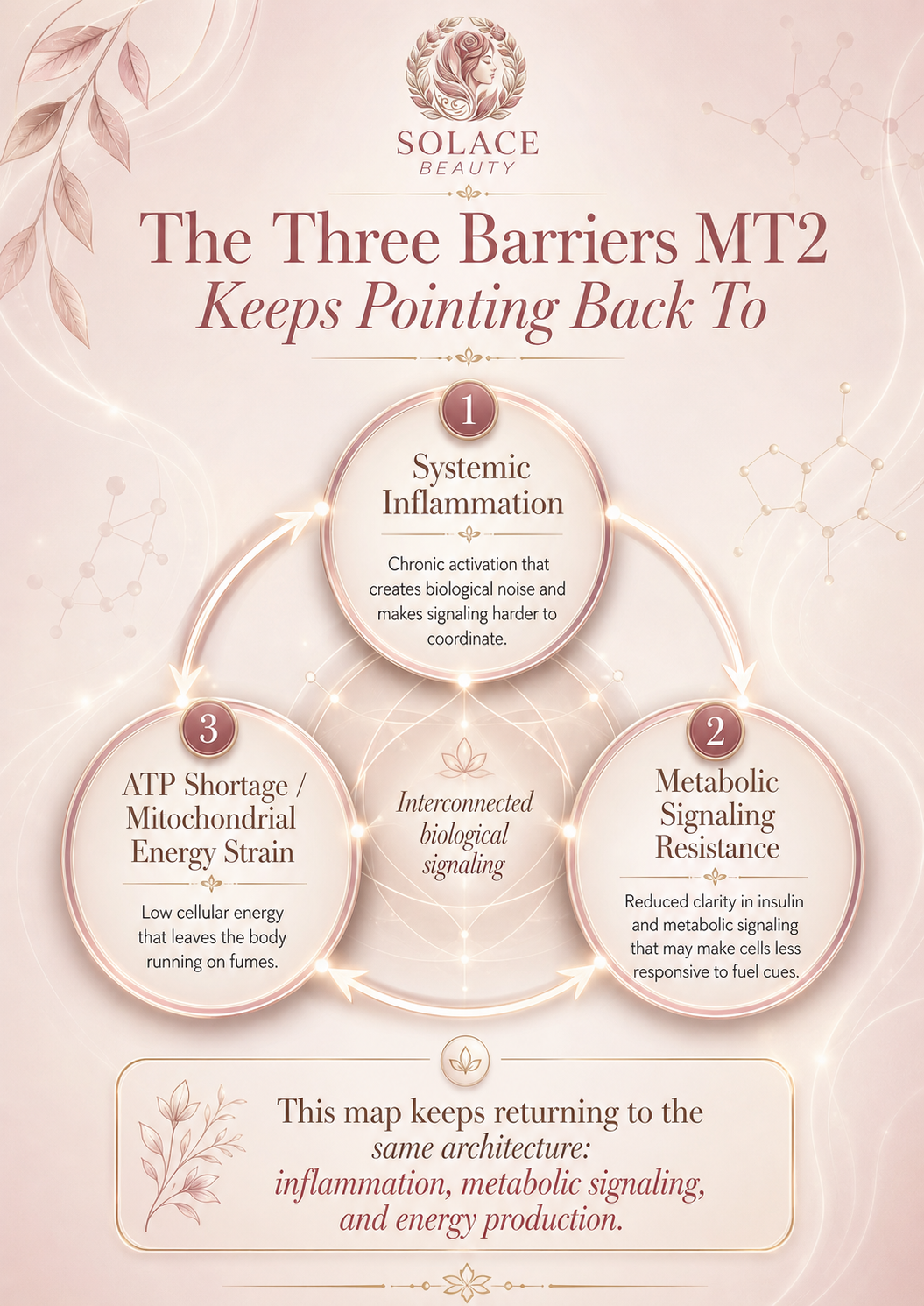
The first barrier is inflammatory tone. When the body is in a state of high activation, the resulting signaling can drown out the delicate messages required for metabolic health and cognitive clarity. In the context of the melanocortin system, we explore the concept of an internal "brake signal" that may help the body transition away from chronic activation and toward a more regulated state.
The second barrier involves how cells receive and interpret fuel signals. When the body experiences insulin signaling resistance, cells become less responsive to the body's internal energy cues. This disruption in metabolic communication shapes how the body manages appetite, energy storage, and overall metabolic flexibility.
The third barrier is the availability of cellular energy, or ATP. When your mitochondria, the cellular power plants, are under strain, the body effectively begins "running on fumes." Without sufficient ATP, the biological systems required for repair, neurovascular function, and cellular resilience may lack the energy needed to operate at their full potential.
Section Eleven
The melanocortin system is a subject of significant interest in advanced clinical research. Because these receptors are distributed across almost every organ system, scientists are investigating how this signaling map touches areas far beyond skin and libido.
Within disease-adjacent research, focus is often placed on the following signaling pathways:
These areas of study are part of a sophisticated scientific conversation. If you have concerns regarding your neurological, cardiovascular, or renal health, it is essential to seek the guidance of a qualified medical professional. Full clinical context and professional oversight are required for any health condition.
Section Twelve
In a world where health is often reduced to "hacks" and "shortcuts," it is easy to see why Melanotan 2 has been misunderstood as merely a cosmetic tool or a temporary libido fix. However, as this map has shown, those effects are only localized expressions of a much deeper signaling system.
“This ebook is not a tanning protocol, nor is it a libido protocol.”
We have intentionally omitted dosing schedules, route instructions, and sourcing guidance. Peptides are not simple lifestyle supplements; they are signaling tools that may communicate with the body's regulatory systems.
Responsible peptide-awareness means recognizing that "more" is not automatically better. Any introduction of a new signal must be done with an understanding of your unique biological context:
The goal of this guide is to move away from reckless self-experimentation and toward a model of informed, provider-guided responsibility. True body intelligence is about asking the right questions, not following a generic protocol.
Section Thirteen
You do not need to walk into an appointment with conclusions. You can walk in with better questions.
When discussing the melanocortin system or advanced signaling molecules with a healthcare professional, the goal is to bridge the gap between your goals and their clinical expertise. Use the following questions to guide your next consultation.
Can we discuss whether the melanocortin system is relevant to my goals?
Why I'm asking: To determine if supporting these specific signaling pathways aligns with my personal biological needs.
Can we discuss inflammation markers and immune tone?
Why I'm asking: To see if 'biological noise' or high inflammatory signaling is a barrier for my overall health.
Can we review metabolic markers like fasting glucose, fasting insulin, A1C, lipids, or other provider-directed labs?
Why I'm asking: To evaluate how clearly my cells are currently hearing metabolic and fuel signals.
Can we discuss mitochondrial energy and fatigue patterns?
Why I'm asking: To understand if energy production at the cellular level is influencing how I feel.
Can we discuss libido as a neurovascular and hormonal conversation?
Why I'm asking: To explore my concerns through a comprehensive lens of blood flow, nervous system tone, and hormones.
Can we discuss whether Melanotan 2 is appropriate or inappropriate in my situation?
Why I'm asking: To seek an expert opinion on whether this specific signal is safe for my unique body terrain.
Can we review risks, contraindications, route, dosing, monitoring, and interactions only under qualified guidance?
Why I'm asking: To ensure any potential use is managed with the highest standard of safety and clinical oversight.
Can we discuss skin history, mole history, sun exposure, and dermatology considerations?
Why I'm asking: To ensure skin signaling is addressed with professional dermatological awareness.
Can we discuss hormone history, cardiovascular health, medication history, and nervous system stress?
Why I'm asking: To provide a complete picture of my health that may influence how I respond to new signals.
What should we monitor if peptide therapy is being considered?
Why I'm asking: To establish a clear and responsible framework for lab work and safety checks.
Section Fourteen
As we reach the end of this journey through the melanocortin system, the landscape likely looks much different than it did when you first opened these pages.
We live in a culture that is often quick to reduce complex biology to aesthetic outcomes. In that world, Melanotan 2 is a "tanning peptide" or a "libido shortcut." But as we have explored, those surface-level associations, while rooted in biological signaling, are only small fragments of a much more significant story.
“Melanotan 2 is not just a tanning peptide. It is a melanocortin signal.”
If there is one truth we hope you take away from this guide, it is this: Your body is not a collection of separate symptoms. It is a network of signals asking to be understood. Skin, libido, appetite, metabolism, inflammation, immune tone, and cellular energy are not isolated departments; they are connected threads in a single, elegant tapestry of communication.
Advanced peptide-awareness is not about chasing shortcuts or bypassing the body's wisdom. It is about understanding the biological terrain and respecting the signals the body sends. True body intelligence means moving away from the noise of "hacks" and toward the clarity of responsible learning and provider-guided context.
This guide is not intended to be the end of your conversation, but rather a doorway. By learning the language of your own biology, you move from a place of confusion and shame toward a place of grounded responsibility.
Your journey toward understanding your body is an ongoing practice of listening. We invite you to carry this map forward, using it to ask better questions and build a deeper connection with the sophisticated system that is your body.
Bonus One
The five signal layers, at a glance.
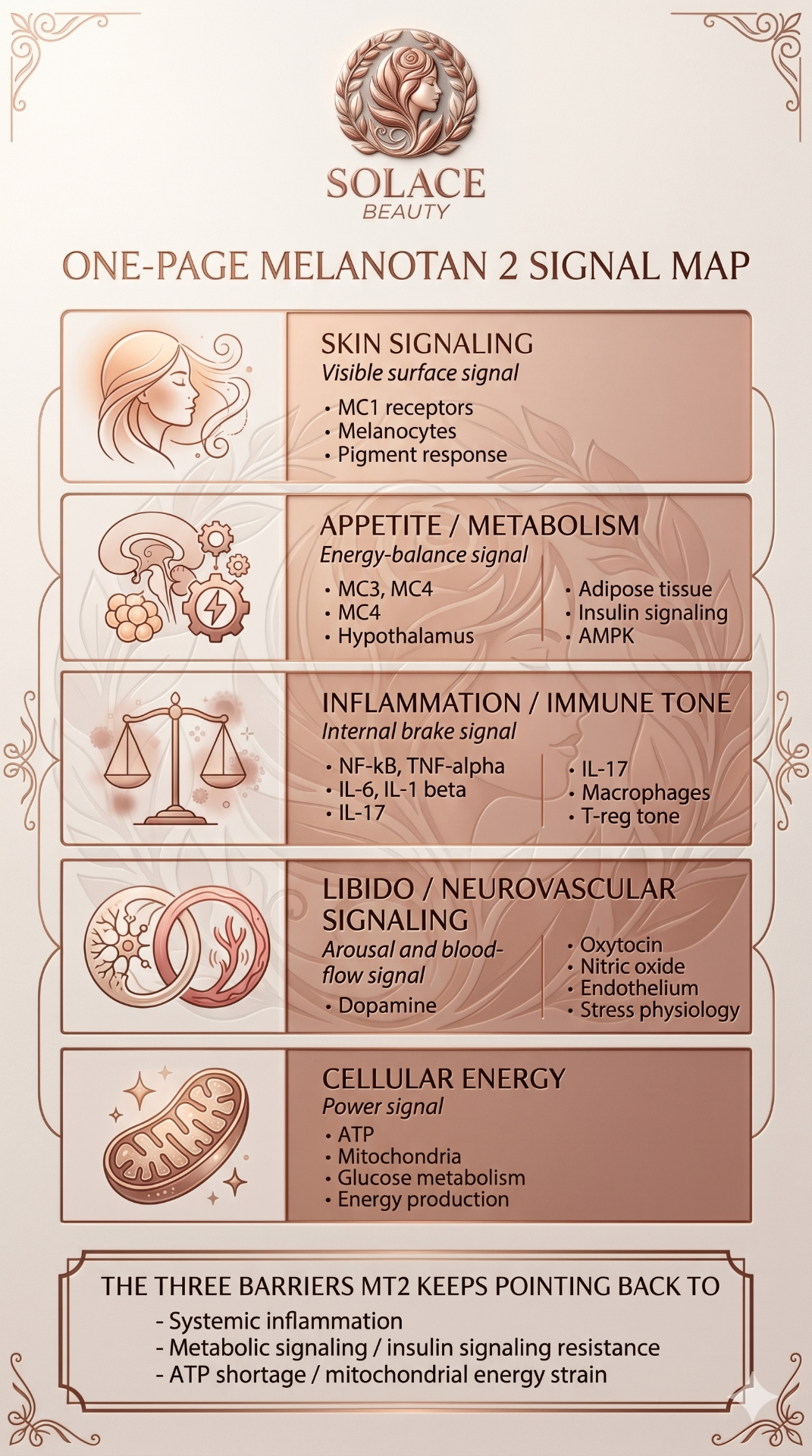
MC1 receptors, melanocytes, and the visible pigment response.
MC3, MC4, the hypothalamus, adipose tissue, insulin signaling, and AMPK.
NF-kB, TNF-alpha, IL-6, IL-1 beta, IL-17, macrophages, and T-reg immune tone.
Brain arousal centers, dopamine, oxytocin, nitric oxide, the endothelium, and stress physiology.
ATP, mitochondrial function, glucose metabolism, and energy production.
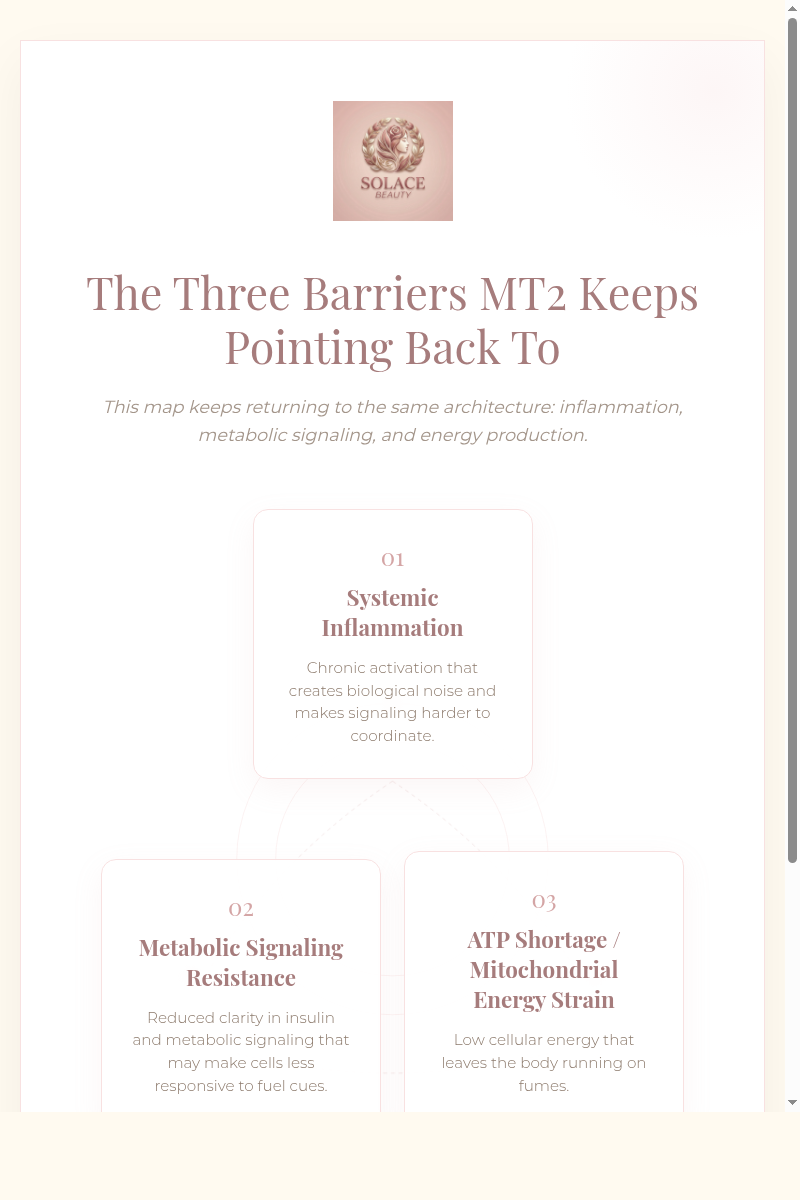
Chronic activation that creates biological "noise."
Resistance in insulin signaling that makes cells less responsive to fuel.
Mitochondrial energy strain that leaves the body running on fumes.
Bonus Two
Bonus Three
You do not need to arrive with conclusions. You can arrive with clearer questions.
Solace Beauty
Educational awareness only. Not a dosing protocol, injection guide, sourcing guide, or peptide stack plan.
Closing
Calm, science-forward body-intelligence education on beauty, metabolism, peptides, recovery, cellular energy, and advanced wellness signaling.
“Your body is not broken. It is always communicating. Solace Beauty helps you learn how to listen.”
Educational note
Use this guide as a signal map for reflection, better questions, and calmer provider-guided context. When you want to continue, the wider Solace ecosystem is here through ebooks, peptide education, the library, assessments, the journal, and contact pathways.